Every piece of equipment used on a Standardbred racehorse has been selected specifically for that horse's individual needs. This guide will explain some of the equipment most frequently asked about by newcomers to the racetrack.
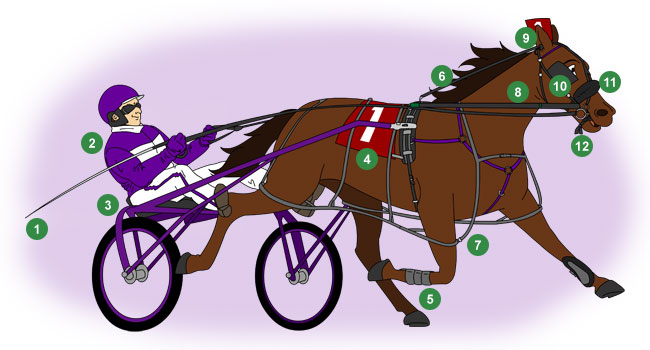
1 A WHIP is used to encourage the horse to move forward. The driver strikes the saddle pad or racebike shaft to signal to the horse to keep trying its best.
2 DRIVING COLORS are worn by the driver in a race. The designs are specific to each driver, so no matter what horse they may be driving, at whatever track, they always wear the same colors.
3 The RACEBIKE, or sulky, is the lightweight cart used by the driver. The lower and closer the driver is to the horse, the more aerodynamic he will be.
4 The SADDLE PAD (along with the head number) identifies the horse's number in the race program. Sometimes the saddle pad will show a smaller number, too, which is the race number.
5 BOOTS guard the legs against injury. Sometimes a horse's hoof will touch another leg, especially if it is off-stride
6 An OVERCHECK is a strap that attaches to a bit in the horse's mouth, goes over its head and between its ears, and hooks to the harness. It helps keep the horse's head level and its gait steady.
7 HOBBLES are loops that go around the horse's legs to keep them on gait (see page 4). Pacing hobbles connect the legs on each side, while trotting hobbles connect the front legs to a pulley underneath the horse's belly.
8 A HEADPOLE prevents the horse from turning its head, which may cause it to go off-stride.
9 EAR PLUGS keep a horse calm, especially before and at the beginning of the race. Most ear plugs have a strap that connects to the driver's foot so that he can remove them, signaling to the horse that it is time to finish strongly.
10 A "blind" BRIDLE prevents a horse from seeing directly behind them or to the side, which allows more anxious horses to focus only on what is happening in front of them.
11 A SHADOW ROLL, like the blind bridle, keeps the horse's attention on the race ahead, instead of looking for shadows near its feet.
12 A TONGUE TIE is a soft piece of fabric that goes around the tongue and ties under the chin. It keeps the tongue from getting over the bit, which can impede breathing and make the horse uncontrollable.
